Leveling casters — aluminium-core PU wheel series.
A polyurethane tread on an aluminium core gives this leveling series its roll: resilient like a PU caster wheel, light like aluminium, on the same geared leveling mechanism. Five plate classes to 1,000 kg per unit.
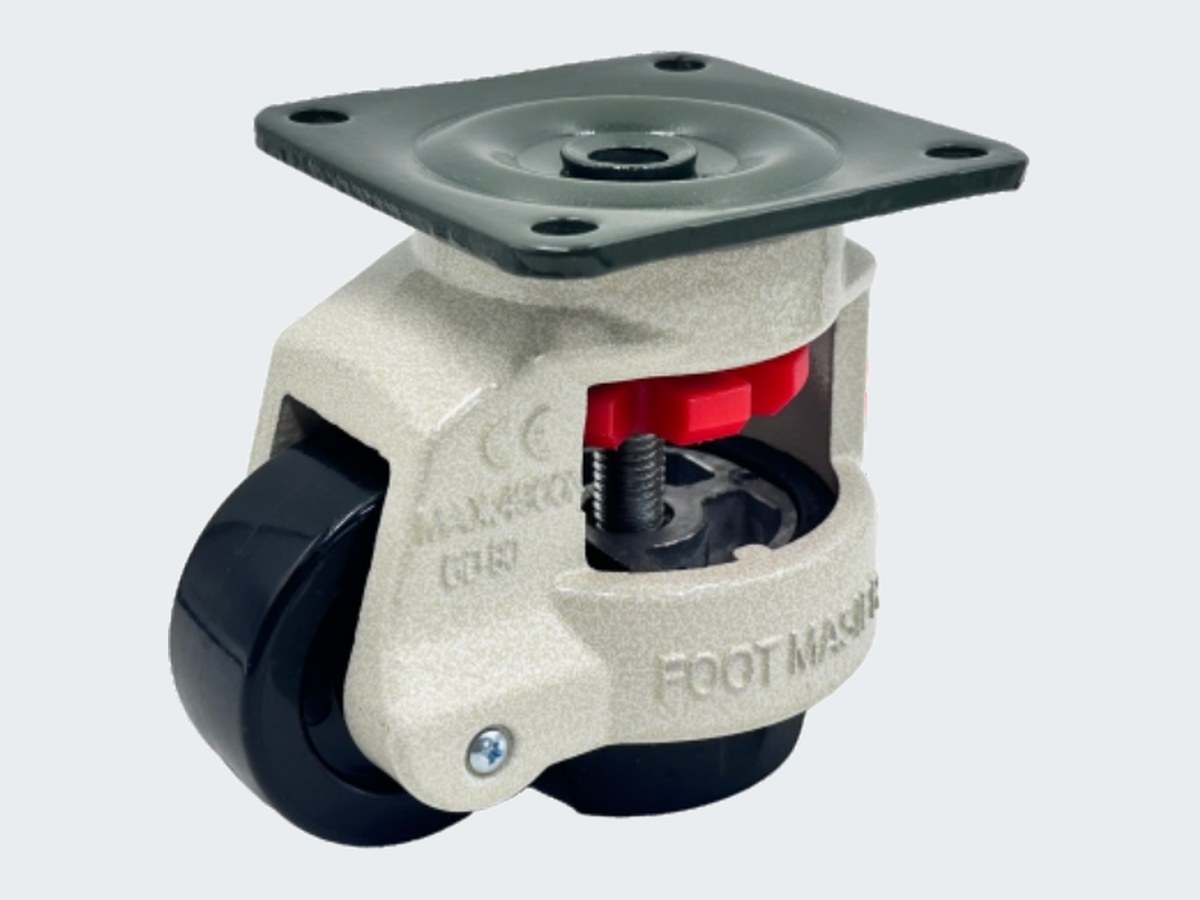
Specification
| Series | Leveling casters — top plate, aluminium-core PU wheel |
|---|---|
| Size classes | 40 / 60 / 80 / 100 / 120 |
| Load basis | Per unit in the levelled state; set-of-four values in the size table |
| Wheel | Polyurethane tread on aluminium core, 42–75 mm diameter |
| Adjustment | Internal gear, turned on the housing |
| Mounting | Top plate — pattern per size class in the table |
| Documentation | CE / RoHS documentation available on request — ask in the RFQ and the documents for this series accompany the quotation. |
| MOQ | Confirmed per order in the written quotation |
| Lead time | Confirmed per order in the written quotation |
Values marked as a class or target are the specification this model is quoted and sampled against. Final confirmed values are stated on the written quotation and verified on the production sample before bulk production.
For equipment that moves often — production cells that re-layout, test rigs that shuttle between bays — the wheel on a leveling caster stops being an afterthought. This series fits the aluminium-core polyurethane wheel: the PU tread protects the floor and absorbs the joints, the aluminium core keeps the unit's own weight down, and the rolling effort stays low even at the heavier classes.
The series is also built in solid-colour wheel and black housing variants on the same mechanism and table — state the variant in the RFQ. Ratings and plate patterns are as tabled below.
Sizes in this series
| Size class | Set of 4 load | Per unit load | Top plate | Hole spacing | Hole Ø | Levelled height | Wheel Ø × width |
|---|---|---|---|---|---|---|---|
| 40 | 100 kg | 50 kg | 55 × 55 | 42 × 42 | 6.5 | 71 + 10 | 42 × 20 |
| 60 | 500 kg | 250 kg | 73 × 73 | 58 × 58 | 7 | 82 + 10 | 50 × 25 |
| 80 | 1,000 kg | 500 kg | 90 × 90 | 70 × 70 | 9 | 102 + 15 | 63 × 28 |
| 100 | 1,500 kg | 750 kg | 95 × 95 | 70 × 70 | 11 | 120 + 12 | 75 × 30 |
| 120 | 2,000 kg | 1,000 kg | 95 × 95 | 70 × 70 | 11 | 120 + 12 | 75 × 30 |
Height is stated as nominal height + adjustment travel, as printed in the series table. Read capacity per unit in the levelled state; the set-of-four figure assumes an evenly loaded machine on a flat floor. Dimensions in millimetres unless shown otherwise. Values are the series table values; the written quotation confirms the final drawing for your size class before sampling.
Configuration options
- Solid-colour wheel and black housing variants on the same table — state the variant in the RFQ.
- Standard nylon wheel build — see the plate series.
- Replacement pads reorderable against your locked specification.
What the sample verifies
Before bulk production, the production sample of this series is checked against the locked specification: wheel diameter and — critically — wheel width measured, tread hardness verified where the series states it, bearing type confirmed, fork and plate dimensions measured, and load performance tested per the stated convention (EN 12532 / ANSI ICWM). The approved sample becomes the reference for the shipment, and the order carries batch traceability back to it.
Request pricing for this series
About this series
How should I read the load figures?
Per unit, in the levelled state — that is the working condition the rating describes. The set-of-four figure is the evenly loaded total across four units. For uneven floors, size from the per-unit figure with margin, the same divide-down discipline as any caster line.
Why choose the aluminium-core PU wheel?
Rolling quality and unit weight. The PU tread is the floor-friendly, joint-absorbing surface; the aluminium core avoids the weight penalty of a cast-iron core at these sizes. The levelling mechanism and ratings are unchanged.
Is the PU wheel suitable for standing load?
In the levelled state the wheel is unloaded by design — the machine stands on the pad. Standing-load flat-spotting is a rolling-caster problem this mechanism removes.
Need this caster under your own brand?
Private label, custom packaging and carton marks are available across the range — mention it in the RFQ and the quotation will include the branding steps.